
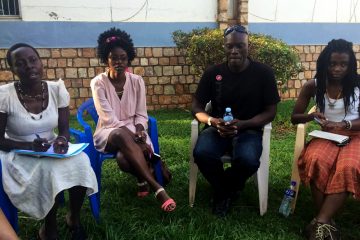
By Assoc. Prof. George Kyeyune
Start Journal of Arts and Culture is coming back after a break of almost a year. The break was necessary for its internal adjustment and re-organisation to set it on a new footing. It now has a new editorial team that constitutes high profile Africanists: Prof. Sidney Littlefield Kasfir, Assoc. Prof. George Kyeyune, Dr. Angelo Kakande and Ms. Margaret Nagawa.
Tag: Angelo Kakande

By Angelo Kakande. Although military dictatorship has distorted governance, the rule of law and constitutionalism, and caused fear, hopelessness, loss of life and property throughout Uganda’s post-colonial history, it is also a rich and productive metaphor whose visual expression is steeped in a corrupted Western concept[ion] of modern public opinion. In this article I engage this proposition to re-examine selected artworks in the context of Uganda’s socio-political history in the period 1986-2016 – a period of Uganda’s history dominated by the ruling National Resistance Movement (also called the NRM).
Read More >>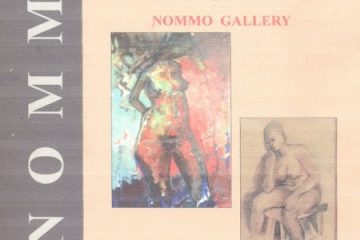
In this second part of a three-part essay, Angelo Kakende reviews many of the paintings depicted in Nude 2000 and Nude 2001: “In summing up, Nude 2001 grew from the success of Nude 2000; the two shows had a common agenda of mystifying the naked body. I however submit that that is not what is should be remembered for. In my opinion, it should be remembered for providing an occasion of the artists to explore the nude for art and for purposes of contributing to socio-political discussions in the country.”
Read More >>
Once prophets, kadongo kamu musicians can no longer stand out from the sea of songs on the radio as a leading voice of expression. Through FESTAC, personal memories and Michael Kiwanuka, Serubiri Moses uncovers the politics of kadongo kamu.
Read More >>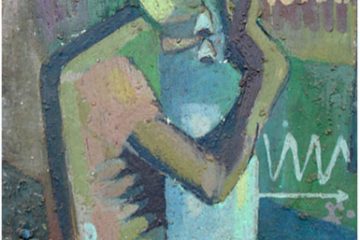
Between 8 December 2011 and 8 January 2012 the Institute of Heritage Conservation and Restoration hosted the 100 Posters for the Right to Education Exhibition to celebrate the International Human Rights Day. In this essay Dr. Angelo Kakande analyse a selection of posters to expose the visual and legal issues behind the right to education in Uganda and the point at which the exhibition intersected with this right.
Read More >>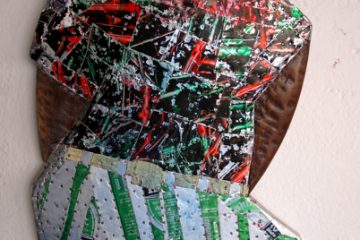
In this essay Angelo Kakande F.J. reviews the themes of woman and man as visualised in Lilian Nabulime’s recent exhibition ‘Sculptural figures reflected on daily experiences’. He shows how a creative enterprise, shaped by formal art education, is interwoven into specific historical circumstances. He submits that through her sculptures Nabulime attempts to challenge masculine power.
Read More >>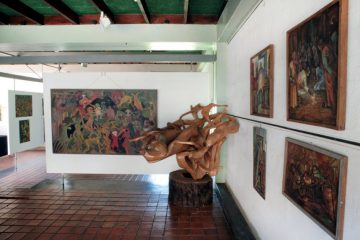
In this essay Dr. Angelo Kakande reviews The Early Years: Paintings from the Collection, 1960s-Mid 1980. He places it in Uganda’s history since 1958. In the process he revises some of the positions taken by its organisers; while he questions others. He demonstrates and argues that a contemplation of the wider context of Uganda’s social, economic and political history, which is embodied in some of the works on show, reveals not simply a failed past, but also a pathetic presence and an uncertain political future.
Read More >>
This year the joint faculty exhibition at Makerere University’s Fine Arts Department ”Different but One” celebrates its 15th year. Startjournal.org would like to honour 15 of the inspiring faculty artists by displaying 15 artworks from the current exhibition. Please enjoy and comment their work.
Read More >>