
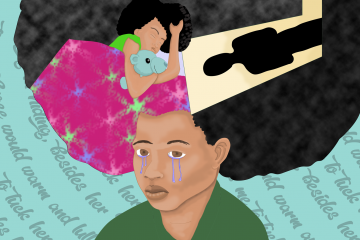
…The repetitive phrases in “Embraces at Bedtime” call to mind the intimacy and comfort lost between a mother and her daughter when the mother is scarred by sexual abuse from their own childhood. The underlying narrative casts a sinister shadow
Read More >>
Category: Poetry & Literature
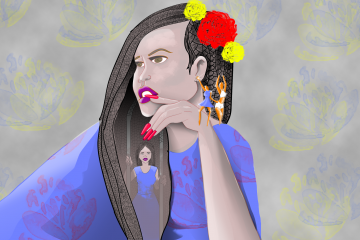
In “What it is”, Arinda returns to the theme of abuse and traces the cycles of violence, pain, and (internalised) patriarchy from formative experiences of girlhood to relate them to womanhood as Ugandan women may experience it now.
Read More >>
Writer Gloria Kiconco introduces a new poetry series by Daphine Arinda titled “What it is”, The series traces the journey from girlhood to womanhood. Arinda is one of the few poets in Uganda to explore erotica, a genre that is challenging, sensitive, and often politicised. It is easy to dismiss erotica as a genre. It is easy to assume it has no power or deep social and political influence because it is pornographic.
Read More >>
In the poem “Loose”, Daphine Arinda satirises the term used to describe women who are comfortable expressing their sexual desires. A woman who dresses sexy, dances wildly, enjoys sexual encounters is labelled “loose”. She is more of a threat because she does this for herself. Arinda claims this word for a positive use, aligning it to its other meaning, one akin to freedom. The woman in this poem becomes one who is free to enjoy her sexuality, saying, “But dignity and self-respect are MINE/ mine to lose.”
Read More >>
You walk my city With the freedom of sure feet Which touch inch and inch of sacred land Aware of the pleasure induced Aware that this is a trespass. My body is a curving case of crystals With each fondle,
Read More >>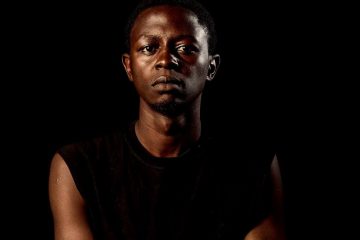
“When the late Joseph Walugembe was still the Director of the Uganda National Theatre, he once explained to my friends and I of the Lantern Meet of Poets how our poetry was different from that of the 70’s, 80’s and 90’s. I recall him emphasizing how the memorized and dramatized performance of our poetry was the main ingredient. Up to that point I had never considered memorized oral expression of poetry even as aspects of poetry”. Kagayi Ngobi talks about his journey into poetry.
Read More >>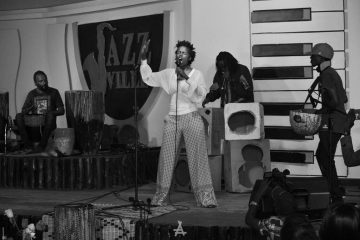
In this poem, Daphine Afinda reflects how daring it is to choose the writing profession in Uganda considering the challenges that surround it. Aware of all the risks and the fears, she still dived right into the dream and in December, 2017 and hosted her first ever Poetry Recital.
Read More >>
Last year in March, 32°East, a centre for contemporary arts in Uganda run a art writing residence for three months at their premises in Kansanga. The program co-sponsored by the British Council and Startjournal.org had one art writer, Dominic Muwanguzi, researching and producing articles that were published in the online journal.
Based from his experience from the residency, Muwanguzi a seasoned art journalist working in Kampala became more confident in his writing. For once, he became aware of the relationship that exists between writer, artist and audience.
This petite and easy read is a testament to the importance of telling our own stories. We usually talk about this in reference to being African; outsiders have been telling our stories since before the days of Heart of Darkness, a book published more than a hundred years ago that continues to define the continent in the minds of many. Today we have movie stars like George Clooney, Angelina Jolie and Ben Affleck, testifying in front of American Congress or on CNN as “African experts”. It is no wonder that we continue to feel misrepresented or invisible, that millions of dollars are spent annually on aid programs that are later found to not work.
Read More >>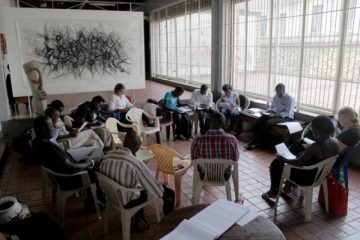
Review By Moses Serubiri on Nudity at Tackling Texts On 19 February 2014, a meeting of artists, art lecturers, students and arts managers convened at the Makerere Art Gallery for the year’s first Tackling Texts, a forum to engage African
Read More >>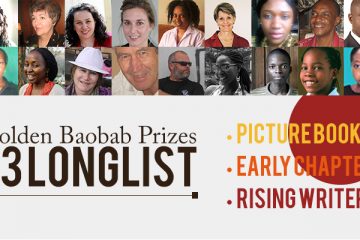
When the 2013 Golden Baobab Prizes longlist was announced over two weeks ago, we were curious to see how many of the writers would be from Uganda. The answer is one. Derek Lubangakene is on the longlist for the Golden Baobab Prize for Early Chapter Books for his story Of Ghosts and Grave-Robbers. By Nanama B. Acheampong.
Read More >>
“What is art? What is culture? If you are able to define it, then you know you are in trouble. How does Arts writing come into the picture? There is a myth that it is about judging something from very good to very bad, but the criteria for evaluating artworks are multi-dimensional.” Editor Thomas Bjørnskau writes his farewell note, and hands over Start to a new team.
Read More >>
“If there is a truth to be admitted to, I will concede this one; it feels like truth, scabrous, incomplete and grudgingly accepted: being a writer is like going on being married. You arrive at a point in it where you no longer have the energy to learn to live with a new person and hold down your peregrinations.” An essay on writing by Ugandan writer AK Kaiza.
Read More >>“The doubts hound: Am I really good enough? Who am I to think I have new stories to tell and a new way to tell them? But I have to go on because I have an ego that feeds on words, mine and anyone else’s. I need to prove that I can do it. At the core though, I write in an attempt to make sense of this world. Who and what and why are we? Why do we do what we do, to ourselves and to one another? Why can’t we stop?” An essay on writing by Ugandan writer Doreen Baingana.
Read More >>Samson Ssenkaaba aka Xenson graduated in 1999 from the Margaret Trowell School of Industrial and Fine Arts, Makerere University majoring in graphic design and painting. Since then, his works have been shown in numerous exhibitions and fashion shows in Uganda and abroad. Read his poem ‘Art, that that…….’
Read More >>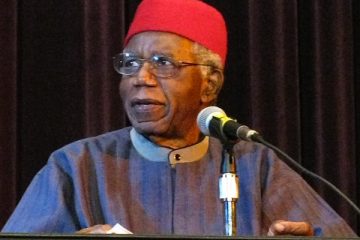
Unarguably he was one of the most-read writers from the African continent, selling more than 8 million copies. His book Things Fall Apart is the most widely read book in African literature and the most translated. While a whirlwind of tributes has poured in in the wake of Achebe’s death, we have been left to ponder his contributions to African literature and the literature body generally, and to see if he rightfully deserved the continent’s honor: The father of modern African literature. And while at it, also weigh the relevance of his work to the present generation.
Read More >>
Faisal Kiwewa, the Director of Bayimba Cultural Foundation, spoke on “Arts and Arts Education: Lovely or Essential?” on 12th March 2012 at The Hub in Kamwokya. It hinged on principles gleaned from Eliot W. Eisner’s The Arts and the Creation of Mind and the verve of Bayimba’s work with local artists.
Read More >>
Startjournal hereby publish the 2nd runner-up of Femrite’s Writing Competition under the theme ‘My Uganda @50?. The short story ‘My Uganda @50’ is written by Kaigo Betty.
Read More >>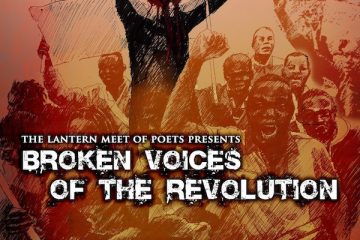
The Lantern Meet of Poets is made up of mostly university students who share one thing in common. They were born in the 1980’s—at the time when the National Resistance Army (NRA), now the National Resistance Movement (NRM), allegedly liberated this country from bad governance. During this first themed recital and performance, they sounded out their splintered voices from within the revolution. The writing, though familiarly presented, managed to achieve a simmering hyper-realism in the audience.
Read More >>
Startjournal hereby publish the 1st runner-up of Femrite’s Writing Competition under the theme ‘My Uganda @50?. The short story ‘Dependence’ is written by Muriel Baguma.
Read More >>