

Writers and theorists have long misquoted German writer Johann Wolfgang von Goethe (1749–1832) as having said “music is liquid architecture, architecture is frozen music.” It was later adapted to Architecture is Music in Stone. Architect by profession, Oroma Geoffrey soon
Read More >>
Category: Music

In this Design Hustle podcast episode, Patricia Opio speaks to Kamanzi R., a musician and songwriter. She tells us how she navigates the creative industry in Uganda and what drives her in her work as a musician.
Read More >>
In this Design Hustle, we get to talk to Julius Sese, a musician extraordinaire. If you have never heard of him, now you have the chance to get to know all about him and his inspiration for his new album
Read More >>
There is a popular prevailing assumption that when you make a hit song, you break through and achieve lots of success. The reality is very sobering. Every music artist must have a side hustle or alternative streams of income other than recording and performing music. Acaye Elizabeth Pamela dives into the Ugandan music industry and speaks to some key players to investigate where the money is in music.
Read More >>
Bayimba Gulu was dynamic and full of culture. Raymond Omerio Ojakol was there to cover it.
Read More >>
Ugandan Recordings is a Scandal Studios project to uncover and document music from northern Uganda. The search has found artists with a variety of instruments such as adungu, lukeme, nang’a, bila and orak. All recorded songs are accompanied by video clips, so one can see how each artist creates their work.
Read More >>
Mango Roses is a recounting of Uganda’s troubled past weaved through the chaotic journey of two lead female character.
Read More >>
A platform like the Rift Valley Festival can be used to strategically develop ones career, but it is dependent on the vision of the musician. There is no point in going there to just collect contacts. One must follow up with emails or phone calls in order to develop relationships or explore future collaborations.
Read More >>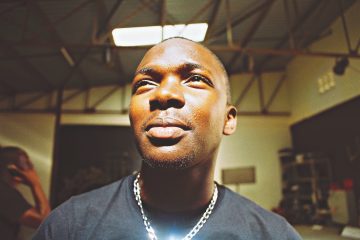
Indeed it seems that the music scene in Uganda is strangled by poor imitations of Dancehall and Reggae. But if we understand the history, the challenges and most importantly the gospel, there emerges soul-filled clarity.
Read More >>
“When I have been surrounded by gracious courteous musicians, the stage has always been a space of incredible intimacy. Those times when I have played in the orchestra have once or twice felt as though I was being swept up by a thunderstorm. You watch the notes lift off the page as you play them; suddenly the world disappears around you.” An essay on music, love and jazz by Serubiri Moses.
Read More >>
“Right now, with the growth of the creative industry globally and the culture of “bling” as perpetrated by mainstream artists, I think a lot of people think it’s a way to make fast money. It looks glamorous, being on stage, mingling with stars, having lots of money—which is a myth, there is always a price to be paid when signed to a major label—nice clothes, fast cars and beautiful men and women around you, but in fact it is a profession that takes a lot of commitment, practice and hard work.” An essay on singing by Ife Piankhi.
Read More >>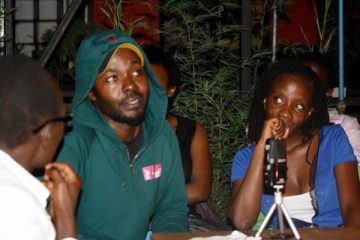
On April 2nd 2013, the guest speaker for Wazo 10 was conceptual and visual artist, musician, filmmaker and poet, Ssenkaaba Samson, who goes by the name Xenson. In his introduction the moderator, David Kaiza, described Xenson as someone whose varied work in fashion, music, poetry and the visual arts has exponentially expanded what we call art and the art space in Uganda.
Read More >>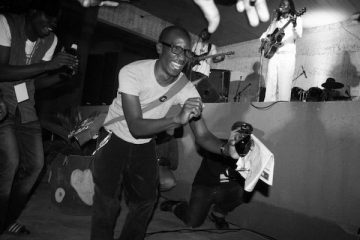
A great number of opportunities at DOA DOA in Jinja this month were snatched by musicians who had managers, PR agents, artist statements and CDs available — in short, professional musicians. This was further explained in a talk by Andrew Dabber about effective marketing. Serubiri Moses reports from DOA DOA.
Read More >>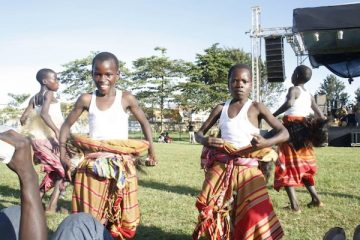
There was that general feeling that the Bayimba Festival in Jinja had not been advertised enough, hence the slow attendance of people. Festivals are supposed to give you that sense of excitement and belonging. It’s hard to get that with a scanty number of people. That aside, the sound of music of its own is bound to bring you numbers since the event was in a public space and considering that shs 1000 is not a lot to pay. On this occasion, there was something missing in the music acts that performed. This festival needed at least one or two big names that are certain crowd-pullers to uplift the mood of the festival.
Read More >>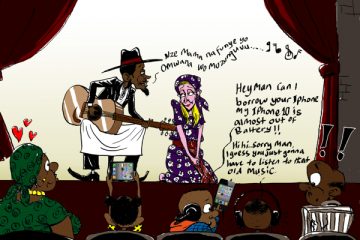
Kadongo Kamu is a musical subculture within Uganda which roots began in the 1950s with the guitarists Christopher Sebadduka and Elly Wamala. This article deals with how this culture has been subverted from mainstream culture through active technological and infrastructural modernization in Uganda from the 1960s till present.
Read More >>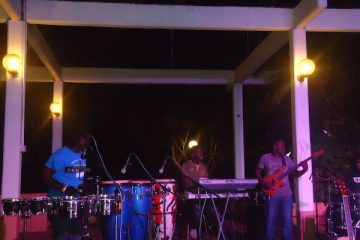
A recent percussion show at the Sheraton Lion Bar collected Kampala’s most sought-after drummers and tried to incorporate the element of hip-hop. But what did it mean for the beatboxers and rappers, who were simply asked to show up even without a soundcheck? Serubiri Moses asks.
Read More >>
From the exposure many Ugandan musicians such as Navio, The Mith, Keko, Lillian Mbabazi and Maurice Kirya are receiving on Twitter, it would not be inappropriate to say that popular Ugandan music is experiencing a boom in Africa. Unfortunately, this has exposed their largely Western aspirations, creating the daunting questions such as: Who is the audience on Twitter? Which culture does one produce for? And, is it possible to produce a cultural following on Twitter?
Read More >>
“When I listen to the latest album of St. Nelly-sade, I can’t stop but muse that, by and by, future hip-hop critiques, collectors, practitioners, etc will reflect upon his music as a one of a kind archetype, and use it to school and inspire the coming hip-hop generations in Uganda.” Lutakome ‘Felix’ Fidelis has met the Ugandan underground rapper.
Read More >>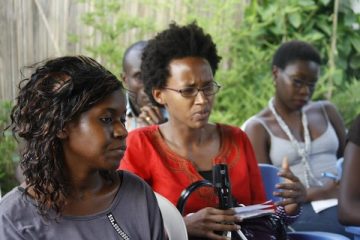
Faisal Kiwewa, the Director of Bayimba Cultural Foundation, spoke on “Arts and Arts Education: Lovely or Essential?” on 12th March 2012 at The Hub in Kamwokya. It hinged on principles gleaned from Eliot W. Eisner’s The Arts and the Creation of Mind and the verve of Bayimba’s work with local artists.
Read More >>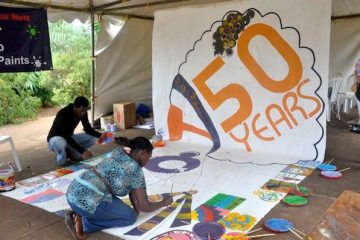
On March 8th, one couldn’t help but wonder how art would be used to celebrate such an interesting phenomenon of the human race. Would it call for a sculpture of the woman in all her glory, a painting of her most-prized assets? Or how she embraces art in her day-to-day life to make it comfortable for herself and her loved ones? Certainly for the international celebrations of the Women’s day at the Sheraton, the answer lay in this last one. The theme of the festival was how independent is the Ugandan Woman? A retrospect of the past 50 years, present and future perspectives.
Read More >>